

Best overall comparison starting point: a capped H-plan. Best for prime-rate borrowing: a P-plan. Best for a smaller deposit: an eligible mortgage-insurance-backed loan. This 2026 guide compares those routes for Hong Kong first-time buyers; your best choice depends on the written bank offer, valuation, deposit and repayment capacity.
- Best mortgage plans for first-time home buyers Hong Kong: compare capped H-plans, P-plans and mortgage-insurance-backed loans.
- A capped H-plan suits buyers who understand HIBOR-linked repayments and the cap formula.
- A P-plan suits buyers who prefer a prime-rate formula; it is not a fixed-rate mortgage.
- Mortgage insurance supports eligible higher-borrowing applications but adds conditions and an insurance premium.
- Onstay provides mortgage referral and brokerage support for Hong Kong buyers comparing bank offers.
Why this matters
Your mortgage decision is not just a choice between interest-rate labels. A bank valuation below the purchase price changes the cash you need, while loan conditions determine whether an attractive offer actually fits your purchase.
Onstay provides mortgage referral and brokerage services to Hong Kong homeowners and property buyers, with over 6,000 handled cases. Onstay provides mortgage referral and brokerage support for Hong Kong first-time buyers comparing bank offers. The bank still assesses the application and decides whether to lend.
For a 2026 purchase, separate three questions: which repayment formula suits you, how much borrowing you qualify for, and which conditions you can accept. Mortgage insurance addresses the second question; it does not replace the first.
What makes the best first-time buyer mortgage?
Judge each offer against these criteria before comparing plan names:
- Repayment formula: Identify the reference rate, adjustment and cap. Understand how each affects the rate you actually pay.
- Approval fit: Check income evidence, existing debts, property eligibility and the bank's valuation. A headline offer is not an approval.
- Deposit requirement: Calculate the cash needed against the approved loan, not an assumed percentage of the purchase price.
- Total borrowing cost: Include interest, mortgage-insurance premiums where applicable, and charges stated in the offer.
- Exit conditions: Read early-repayment terms, benefit clawbacks and restrictions before planning a future refinance.
- Completion readiness: Confirm required documents, outstanding conditions and the drawdown arrangements before relying on the loan.
Choose the offer you can qualify for and repay comfortably, not the offer with the most attractive headline. Keep the same requested loan amount and repayment term across comparisons so differences remain visible.
Hong Kong first-time buyer mortgage options at a glance
These are financing routes, not a ranking of named banks. Mortgage insurance can accompany an eligible mortgage structure, so the third option overlaps with the first two rather than replacing them.
| Option | Best for | Standout feature | Key limitation |
|---|---|---|---|
| Capped H-plan | Buyers comfortable with benchmark-linked borrowing | HIBOR-based formula with a contractual cap | Repayments can change, and the cap itself can depend on prime |
| P-plan | Buyers who prefer a prime-rate formula | Interest linked to the lender's prime rate | Prime can change; the plan does not guarantee fixed repayments |
| Mortgage-insurance-backed loan | Eligible buyers seeking higher borrowing relative to property value | Insurance supports lending above the bank's ordinary uninsured limit | Insurance premium, eligibility rules and additional assessment |
An H-plan is not automatically cheaper than a P-plan. Compare the actual formulas and conditions in the offers available to you in 2026, rather than treating either label as a permanent winner.
1. Capped H-plan: best mortgage for benchmark-linked borrowing
A capped H-plan links mortgage interest to Hong Kong Interbank Offered Rate, commonly called HIBOR, plus a stated margin. The offer also specifies a cap, often expressed through a prime-rate formula. The contract determines the benchmark, reset arrangements and how the cap applies.
The cap limits the rate under the contractual formula; it does not necessarily lock your repayment for the life of the loan. If the cap references prime and prime changes, the ceiling can change too.
Best for: First-time buyers who can track a variable repayment formula and want to compare benchmark-linked bank offers.
Capped H-plan pros
- Readable formula: The benchmark and margin give you a defined basis for checking the interest calculation.
- Contractual ceiling: A cap provides a stated limit under the offer's terms rather than leaving the benchmark formula uncapped.
- Useful comparison baseline: You can compare competing H-plans using their margins, caps, reset terms and exit conditions.
Capped H-plan cons
- Variable repayments: A change in the applicable rate affects the interest calculation and repayment requirements.
- Moving cap risk: A prime-linked cap is not the same as a permanently fixed ceiling.
- More terms to inspect: A low margin alone does not establish the better offer when caps and other conditions differ.
What to check before choosing a capped H-plan
Ask the lender to explain the applicable HIBOR tenor, the margin, the cap formula and when rate changes affect your payment. Request the explanation in writing alongside the offer, not as a verbal summary.
For your 2026 comparison, assess 3 repayment scenarios: the quoted starting rate, the rate at the contractual cap, and the rate after any stated introductory condition ends. These are planning scenarios, not forecasts. If the offer has no introductory condition, replace that scenario with another assumption agreed with the lender.
Do not stretch the purchase budget just because the starting repayment fits. Leave room for household spending, property expenses and changes to income.
Verdict — Buy: Choose a capped H-plan when the full formula is clear and repayments remain manageable under the cap scenario. Do not choose it solely because the initial rate looks lower.
2. P-plan: best mortgage for a prime-rate formula
A P-plan calculates mortgage interest using the lender's prime rate and a stated adjustment, commonly a discount. The lender's prime rate is the reference point, so compare the resulting payable rate rather than the discount alone.
A P-plan is still a variable-rate mortgage. The formula is easier to describe than a benchmark-plus-cap structure, but a change in prime can change what you pay.
Best for: First-time buyers who prefer a prime-rate formula and want to compare the resulting repayment directly with a capped H-plan.
P-plan pros
- Direct reference point: The offer ties the interest calculation to the lender's stated prime rate.
- Simpler comparison within the offer: You can identify the reference rate and adjustment without also evaluating a separate HIBOR formula.
- Clear alternative: A P-plan gives you another structure to assess when an H-plan's reset arrangements do not suit you.
P-plan cons
- No fixed-payment promise: Prime-rate changes can affect repayments.
- Discounts can mislead: A larger discount does not prove a lower payable rate when reference prime rates differ.
- Conditions still matter: Early repayment, benefit clawbacks and approval requirements do not disappear because the formula is simpler.
What to check before choosing a P-plan
Write down the lender's reference prime rate, the adjustment and the resulting payable rate together. Comparing only the adjustment removes the reference point that makes the calculation meaningful.
Ask for a repayment illustration using the same loan amount and term as your H-plan comparison. Then read the early-repayment provisions and any conditions attached to benefits separately from the interest formula.
For a 2026 purchase, choose a P-plan because its written terms suit your finances, not because you expect prime to stay unchanged. Your budget should work without requiring a particular future rate decision.
Verdict — Buy: Choose a P-plan when the resulting repayment and contract terms fit better than the H-plan alternative. Skip it if you are seeking genuinely fixed repayments.
3. Mortgage insurance: best route for an eligible smaller deposit
A mortgage-insurance-backed loan uses insurance to support eligible lending at a higher loan-to-value ratio than ordinary uninsured lending. Hong Kong's Mortgage Insurance Programme has property, borrower and loan requirements that must be checked against the application.
Mortgage insurance protects the lender against covered losses; it does not remove your repayment obligation. It is also not an interest-rate plan, so you must still assess the underlying mortgage formula and terms.
Best for: First-time buyers whose main obstacle is the deposit and who meet the applicable mortgage-insurance requirements.
Mortgage-insurance-backed loan pros
- Deposit flexibility: Eligible higher borrowing reduces the deposit required for the same purchase compared with a lower loan amount.
- Separate financing route: It gives eligible buyers another application route beyond ordinary uninsured lending.
- Structured assessment: The application must satisfy specified insurance and lending requirements rather than relying on a first-time-buyer label alone.
Mortgage-insurance-backed loan cons
- Additional cost: The insurance premium must be included in the financing decision.
- Higher debt exposure: Borrowing more leaves a larger balance to repay for the same property purchase.
- Additional eligibility checks: Bank approval and insurance requirements both matter; neither is automatic.
What to check before choosing mortgage insurance
Confirm the current programme requirements for your property, income circumstances and intended occupation. Ask how the insurance premium is handled and how that treatment affects your loan balance and repayments.
Compare the insured route with an uninsured alternative using the same property purchase. Record the difference in cash needed, total borrowing and repayment obligations; do not reduce the comparison to the deposit alone.
Before committing in 2026, check what happens if the valuation or approved loan is lower than expected. A financing plan that depends on the maximum possible borrowing leaves little room to absorb that difference.
Verdict — Buy: Use mortgage insurance when eligibility is confirmed and the additional borrowing remains affordable. Skip it if the larger repayment leaves your household budget stretched.
How the options are ranked
The ranking follows the criteria above: repayment formula, approval fit, deposit requirement, total borrowing cost, exit conditions and completion readiness. A capped H-plan is the default comparison starting point, a P-plan is the prime-rate alternative, and mortgage insurance addresses a different problem: deposit funding.
This is a decision guide, not a claim that one bank or rate structure always wins. The written offer determines the better mortgage; the plan label only tells you where to start.
How to compare your mortgage offers before signing
Use a single comparison sheet. Keep the requested loan amount, term and property details consistent, and separate indicative illustrations from offers that have completed the relevant assessment.
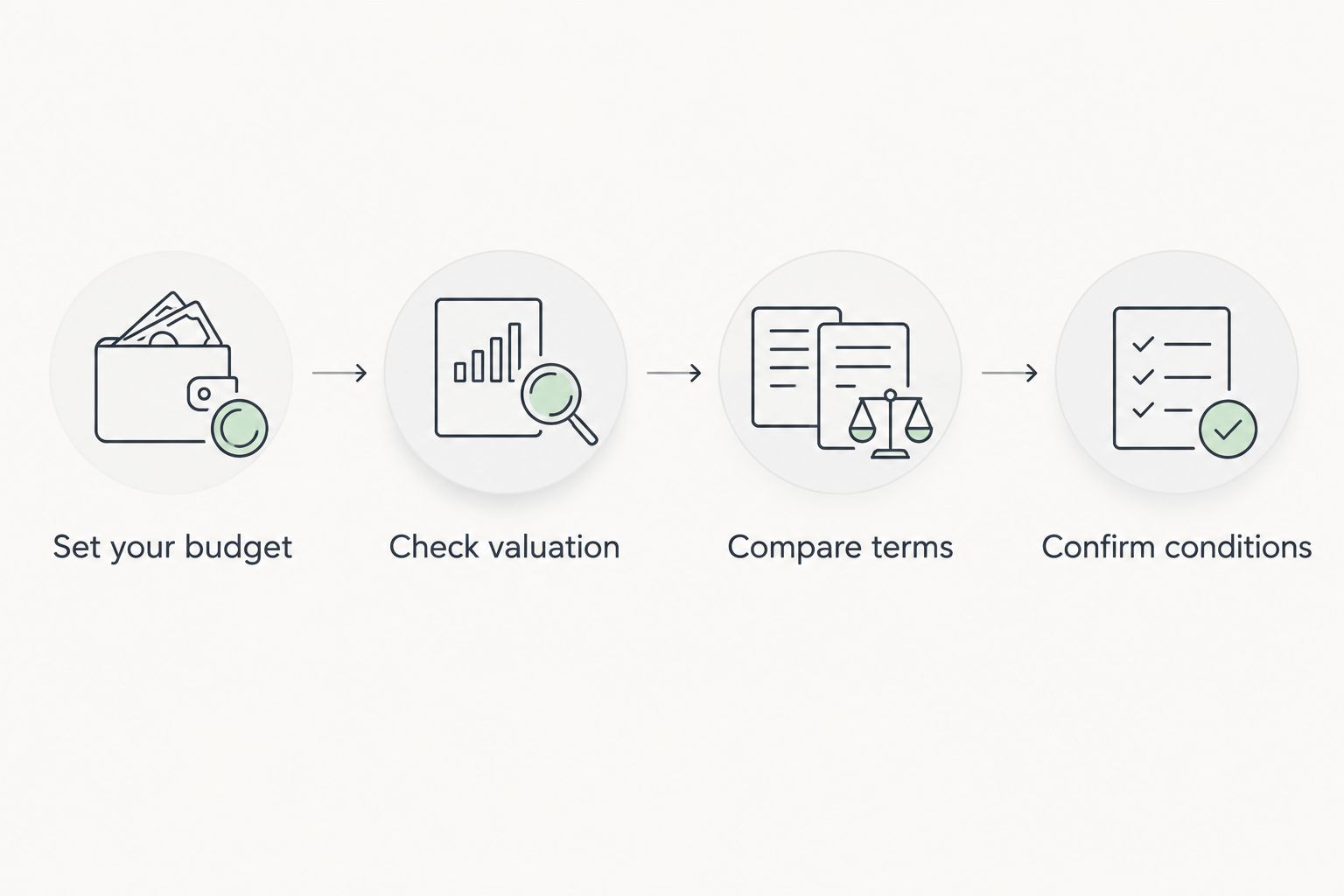
- Set your budget: Review the previous 12 months of household income and spending as a practical starting point. Include irregular expenses rather than using only a convenient recent month.
- Check valuation: Confirm the valuation used for lending and recalculate the cash required if it differs from the purchase price.
- Compare terms: Record the repayment formula, cap, insurance treatment and exit conditions from each written offer.
- Confirm conditions: Identify outstanding documents, approval conditions and drawdown arrangements before relying on the funding.
The 12-month review is a budgeting recommendation, not a statement of bank underwriting requirements. Follow the lender's actual document checklist for your application.
Onstay's mortgage brokerage service supports buyers comparing bank financing. Best for: Buyers who want referral and brokerage support rather than limiting their enquiry to a single bank. Brokerage support does not replace the bank's approval or the borrower's responsibility to read the contract.
Compare your mortgage options
Use Onstay's mortgage referral and brokerage service to discuss bank financing for your purchase.
Which mortgage should you choose?
Start with a capped H-plan, compare a P-plan on identical borrowing assumptions, and assess mortgage insurance separately if the deposit is the constraint. This order keeps interest-rate selection separate from the decision to borrow more.
Choose the offer with an affordable repayment and acceptable conditions after valuation and eligibility checks. If neither offer works without exhausting your cash buffer, revisit the purchase budget rather than searching for a more appealing plan name.
FAQ
What's the best mortgage plan for a first-time buyer in Hong Kong?
A capped H-plan is a useful comparison starting point, not an automatic winner. Compare it with a P-plan using the same loan amount and term, and assess mortgage insurance separately if you need higher borrowing.
Is an H-plan better than a P-plan?
An H-plan is not automatically better than a P-plan. The payable rate, cap, repayment arrangements and contract conditions determine which written offer fits your finances.
Does a P-plan give me fixed monthly repayments?
A P-plan does not guarantee fixed monthly repayments. Its rate follows the lender's prime-rate formula, so a change in prime can affect your repayment.
Does being a first-time buyer guarantee mortgage-insurance approval?
Being a first-time buyer does not guarantee mortgage-insurance approval. Your application must satisfy the applicable borrower, property and loan requirements as well as the bank's lending assessment.
What happens if the bank values the flat below the purchase price?
A lower lending valuation can reduce the approved loan and increase the cash you need to complete the purchase. Ask the bank to calculate the funding requirement using its valuation before relying on your original deposit budget.
Should I choose a mortgage because of a cash benefit?
A cash benefit alone is not a sound basis for choosing a mortgage. Compare the repayment formula and read any eligibility conditions, early-repayment terms and benefit clawbacks in the offer.
What should I check before accepting a mortgage offer in 2026?
Check the approved loan, valuation, repayment formula, insurance treatment and outstanding conditions. Confirm the drawdown arrangements and read the exit provisions before relying on the mortgage for completion.
Can Onstay approve my mortgage application?
Onstay provides mortgage referral and brokerage services; the bank decides whether to approve the loan. Brokerage support does not guarantee approval or remove the lender's assessment requirements.
One last thing
The deposit and the interest-rate plan are separate decisions. An insured mortgage still needs a suitable repayment formula, and an attractive formula does not solve a valuation shortfall. Before accepting an offer, explain both decisions in plain English: how you will fund completion and how you will repay the loan.